

Once you strip out information-only calls and aircraft noise complaints, Chicago logs about 400,000 real 311 complaints a year. Of the 110-plus complaint types in the system, only 29 ever land on a building owner as something to act on. See below for each complaint, grouped by the department that owns each one (keep reading to find out why this is important).
| Code | Type | Department | Closed (LTM) | Median to close |
|---|---|---|---|---|
| BBA | Building Violation | Buildings | 20,314 | 18.1 days |
| BBC | Plumbing Violation | Buildings | 8,821 | 49.0 days |
| BBD | No Permit / Construction | Buildings | 5,218 | 137.7 days |
| BBK | Vacant / Abandoned Building | Buildings | 5,345 | 25.6 days |
| BPI | Porch Inspection | Buildings | 461 | 6.8 days |
| NAC | No Air Conditioning | Buildings | 631 | 0.6 days |
| AAF | Water in Basement | Water Mgmt | 20,916 | 0.1 days |
| WBJ | No Water | Water Mgmt | 4,730 | 0.1 days |
| WBK | Low Water Pressure | Water Mgmt | 2,152 | 1.5 days |
| WCA | Water Quality Concern | Water Mgmt | 471 | 4.9 days |
| WM3 | Check for Leak | Water Mgmt | 11,626 | 1.9 days |
| AAD | Sewer Cave-In Inspection | Water Mgmt | 4,892 | 26.9 days |
| AAI | Alley Sewer Inspection | Water Mgmt | 1,422 | 28.1 days |
| WCA2 | Water Lead Test Kit | Water Mgmt | 6,419 | 137.0 days |
| WCA3 | Water Lead Test Visit | Water Mgmt | 1,955 | 97.8 days |
| SGA | Rodent Baiting / Rat | Streets & San | 44,960 | 3.8 days |
| SEC | Tree Emergency | Streets & San | 30,067 | 0.8 days |
| SDR | Fly Dumping | Streets & San | 17,822 | 5.5 days |
| SCB | Sanitation Code Violation | Streets & San | 15,402 | 4.0 days |
| SCP | Weed Removal | Streets & San | 8,973 | 4.9 days |
| SCT | Clean Vacant Lot | Streets & San | 4,897 | 6.9 days |
| SCX | Recycling Inspection | Streets & San | 292 | 10.0 days |
| SWSNOREM | Uncleared Sidewalk (snow) | Streets & San | 0 | — |
| HDF | Lead Inspection | Public Health | 283 | 1.9 days |
| SHVR | Shared Housing / STR | BACP | 569 | 5.2 days |
| RFC | Renters & Foreclosure | BACP | 41 | 22.8 days |
| SCSP | Shared Cost Sidewalk | CDOT | 12 | 743.6 days |
| EAF | Vicious Animal | Animal Care | 5,662 | 0.7 days |
| FAC | Commercial Fire Safety | Fire | 360 | 11.7 days |
Median days-to-close for complaints calculated by Property Sentinel over the trailing 365 days as of June 2026. Note: the city itself does not publish actual days-to-close stats; we do. Alerts for these 29 complaints are turned on by default for our users' building portfolios. For a richer graphic of all complaints and how they're handled by the city, see below. Or, continue reading for a detailed breakdown of why these complaints should matter to you. None of what is discussed here is legal advice.
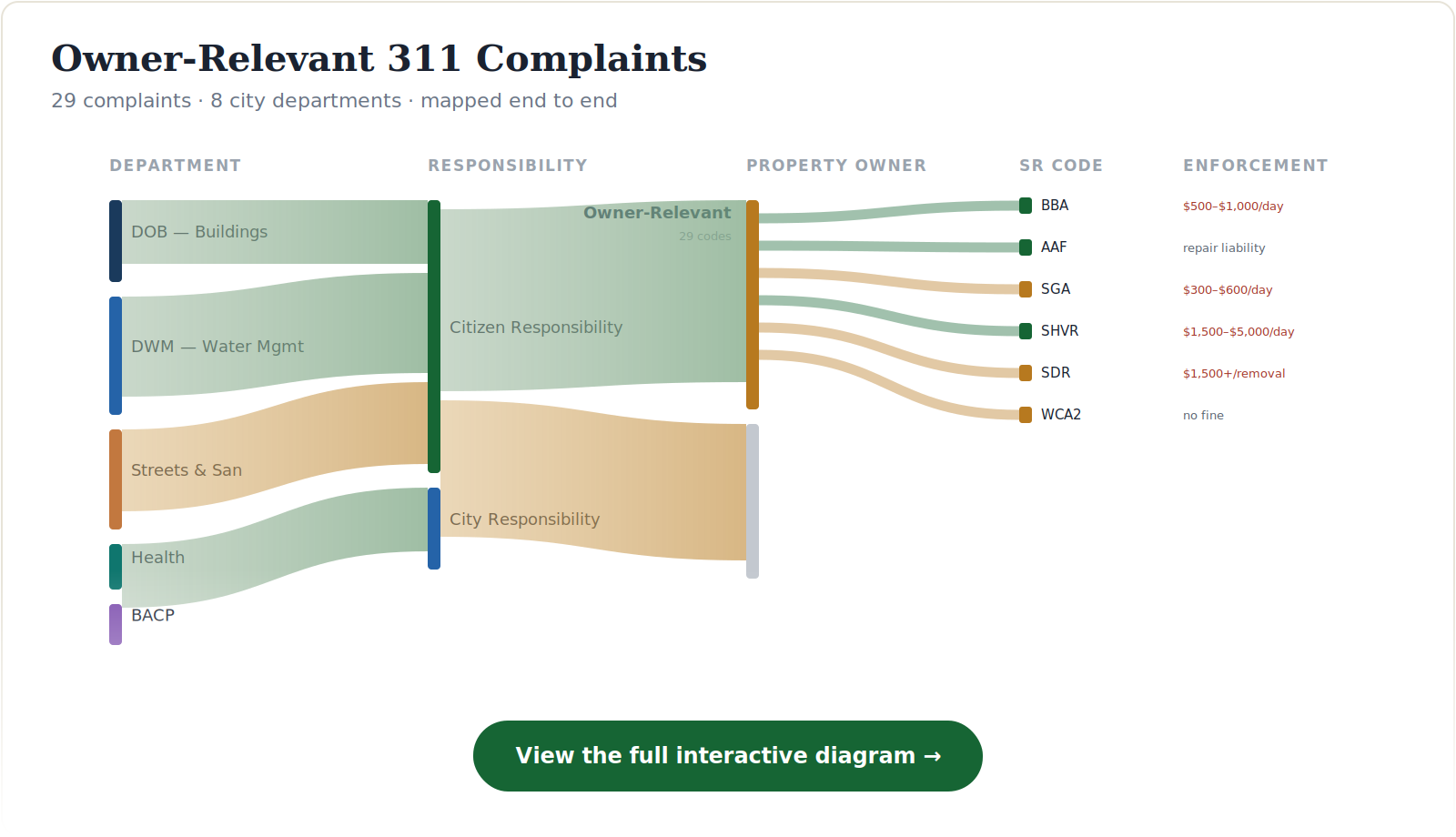
Why the department matters more than the complaint
Three things decide how much any complaint should worry you, and all three flow from which department owns it.
The clock. Different departments have different steps and timelines to close a complaint. Buildings closes a plumbing violation after an inspection, a licensed repair, and a re-inspection (49 days). Water Management closes a basement-flooding complaint in 2.4 hours, because its cure is a technician confirming whose problem it is. Complaints are sometimes rerouted to different departments — if a loud or dirty construction site is reported as a building violation, it may be rerouted to Streets & Sanitation. And for Streets & San it particular, it could be months between a closed complaint and a fine is actually issued.
Who pays. Some complaints are the city's to fix and fund; most owner-relevant ones are enforced through fines, abatement, or liens. A few are ambiguous until resolution: a sewer cave-in is the city's if it's the main, yours if it's the lateral — and you won't know which until the inspector tells you (AAD/AAI, ~27 days, often because someone has to dig).
Whether the fine is real. The dollar figures below are statutory maximums from the Municipal Code of Chicago, not what you'll pay. The gap between the two is the whole game and it splits cleanly by department.
Buildings wants you to comply. Streets & San wants you to pay.
The Department of Buildings owns the violations everyone pictures — building, plumbing, no-permit, porch, vacant, no-heat/AC. The penalty under MCC 13-12-040 reads $500–$1,000 per day, per violation, which sounds ruinous. It isn't, in practice: the department is compliance-first, subordinates to your lender so you can finance repairs, and usually asks only a one-day minimum ($500 owner-occupied, $1,000 investment) to close. Attorney Zack Limbaugh makes this point across two Straight Up Chicago Investor episodes (ep 333 and 2026 follow-up): of every department, Buildings cares most about getting the building fixed, not collecting. The cost is time — the city has only "a few dozen" inspectors — and no-permit cases (BBD) are the cautionary tale: a 138-day median, the slowest quarter dragging past two years, because legalizing unpermitted work after the fact means open walls, new drawings, sometimes a zoning fight. (One trap: the city's violation website is a history of inspections, not current status — the same seven violations re-listed can look like eighty, and the city often never marks corrected ones closed. The document that matters is a signed permit or a final compliance order, which is why we track real status at the address level.)
Streets & Sanitation is the opposite. It owns the outdoor nuisances — rat baiting (the city's single highest-volume owner complaint at ~45,000 cases), weeds and vacant-lot cleanup (abatement-and-lien under MCC 7-28-120), sanitation, recycling, fly dumping — and Limbaugh describes it leaning hard into these as a revenue source. Three things to know: the lag is six-to-nine months from violation to notice; a single debris pile gets cited twice ("trash" and "materials and junk") to double the fine; and the city names anyone "remotely related" to a property then defaults the fines and consolidates liens across all your properties to collect.
The single most useful habit here: if someone fly-dumps on your property, report it to 311 and clean it up. That 311 record is what gets a later Streets & San citation dismissed, because it proves the debris wasn't yours. Almost nobody does this — and it's the clearest reason to monitor the 311 feed at all: the record you file today is the defense you need in six months.
(On snow — SWSNOREM — the ordinance threatens $50–$500/day, but the city essentially never tickets it: zero closed cases all year. Shovel for the slip-and-fall liability, not the fine.)
Water Management, and the lead-test black hole
Nine codes sit with Water Management, and most carry no fine — just repair liability if the problem's on your line. The exception worth flagging is the slowest high-volume complaint in the entire city: the water lead test kit (WCA2) takes a 137-day median to resolve, with the test-visit code (WCA3) at 98. That's not a glitch. Chicago's own water-quality director told the City Council there aren't enough lead-sampling bottles in the country to meet demand, and the program ran zero tests during a maintenance month, leaving residents waiting months or years. When the city says the queue is four months, the data agrees.
The newest trap: the Health Department
CDPH has started sending inspectors to active construction sites for environmental citations — missing dust permits, torn screening, mud tracked off-site. They're brutal: $3,000–$10,000, non-negotiable, and you can't cure them after the fact by pulling a permit. You can have every Buildings permit in order and still get hit, because the health permit is separate and nothing flags it. Confirm CDPH requirements before you break ground. If you make use of our alerts, you can be notified same day of a potential complaint before it gets rerouted to CDPH.
The rest
BACP owns short-term-rental complaints (SHVR, MCC 4-6-300) — $1,500–$5,000/day for unlicensed operation — plus renter/foreclosure matters. Animal Care owns dangerous-animal complaints (EAF, MCC 7-12-090): $300–$500/day plus impound. Fire owns commercial fire-safety (FAC, MCC 15-4): $500/day after a 15-day notice. CDOT owns the shared-cost sidewalk program — an assessment, not a fine.
The same word — "violation" — means comply-on-your-schedule from Buildings and pay-now-maybe-doubled from Streets & San. Knowing the owning department tells you the timeline, the cost, and whether you're even on the hook, before you spend a dollar. It's why we surface the department and code section on every complaint we track, and alert on the ones that matter the day they're filed: the owners the city moves on fastest are the ones who move first, and for the revenue-driven departments, the owner with the record already on file is the one who walks away clean.
Search your address to see every open complaint, violation, permit, and record on any Cook County building — free. More on why one building can hide dozens of PINs and addresses.