

Blog

Property Sentinel field notes and analysis

The 311 Complaints Every Chicago Property Owner Should Know

Once you strip out information-only calls and aircraft noise complaints, Chicago logs about 400,000 real 311 complaints a year. Of the 110-plus complaint types in the system, only 29 ever land on a building owner as something to act on. See below for each complaint, grouped by the department that owns each one (keep reading to find out why this is important).

CodeTypeDepartmentClosed (LTM)Median to close
BBABuilding ViolationBuildings20,31418.1 days
BBCPlumbing ViolationBuildings8,82149.0 days
BBDNo Permit / ConstructionBuildings5,218137.7 days
BBKVacant / Abandoned BuildingBuildings5,34525.6 days
BPIPorch InspectionBuildings4616.8 days
NACNo Air ConditioningBuildings6310.6 days
AAFWater in BasementWater Mgmt20,9160.1 days
WBJNo WaterWater Mgmt4,7300.1 days
WBKLow Water PressureWater Mgmt2,1521.5 days
WCAWater Quality ConcernWater Mgmt4714.9 days
WM3Check for LeakWater Mgmt11,6261.9 days
AADSewer Cave-In InspectionWater Mgmt4,89226.9 days
AAIAlley Sewer InspectionWater Mgmt1,42228.1 days
WCA2Water Lead Test KitWater Mgmt6,419137.0 days
WCA3Water Lead Test VisitWater Mgmt1,95597.8 days
SGARodent Baiting / RatStreets & San44,9603.8 days
SECTree EmergencyStreets & San30,0670.8 days
SDRFly DumpingStreets & San17,8225.5 days
SCBSanitation Code ViolationStreets & San15,4024.0 days
SCPWeed RemovalStreets & San8,9734.9 days
SCTClean Vacant LotStreets & San4,8976.9 days
SCXRecycling InspectionStreets & San29210.0 days
SWSNOREMUncleared Sidewalk (snow)Streets & San0
HDFLead InspectionPublic Health2831.9 days
SHVRShared Housing / STRBACP5695.2 days
RFCRenters & ForeclosureBACP4122.8 days
SCSPShared Cost SidewalkCDOT12743.6 days
EAFVicious AnimalAnimal Care5,6620.7 days
FACCommercial Fire SafetyFire36011.7 days

Median days-to-close for complaints calculated by Property Sentinel over the trailing 365 days as of June 2026. Note: the city itself does not publish actual days-to-close stats; we do. Alerts for these 29 complaints are turned on by default for our users' building portfolios. For a richer graphic of all complaints and how they're handled by the city, see below. Or, continue reading for a detailed breakdown of why these complaints should matter to you. None of what is discussed here is legal advice.
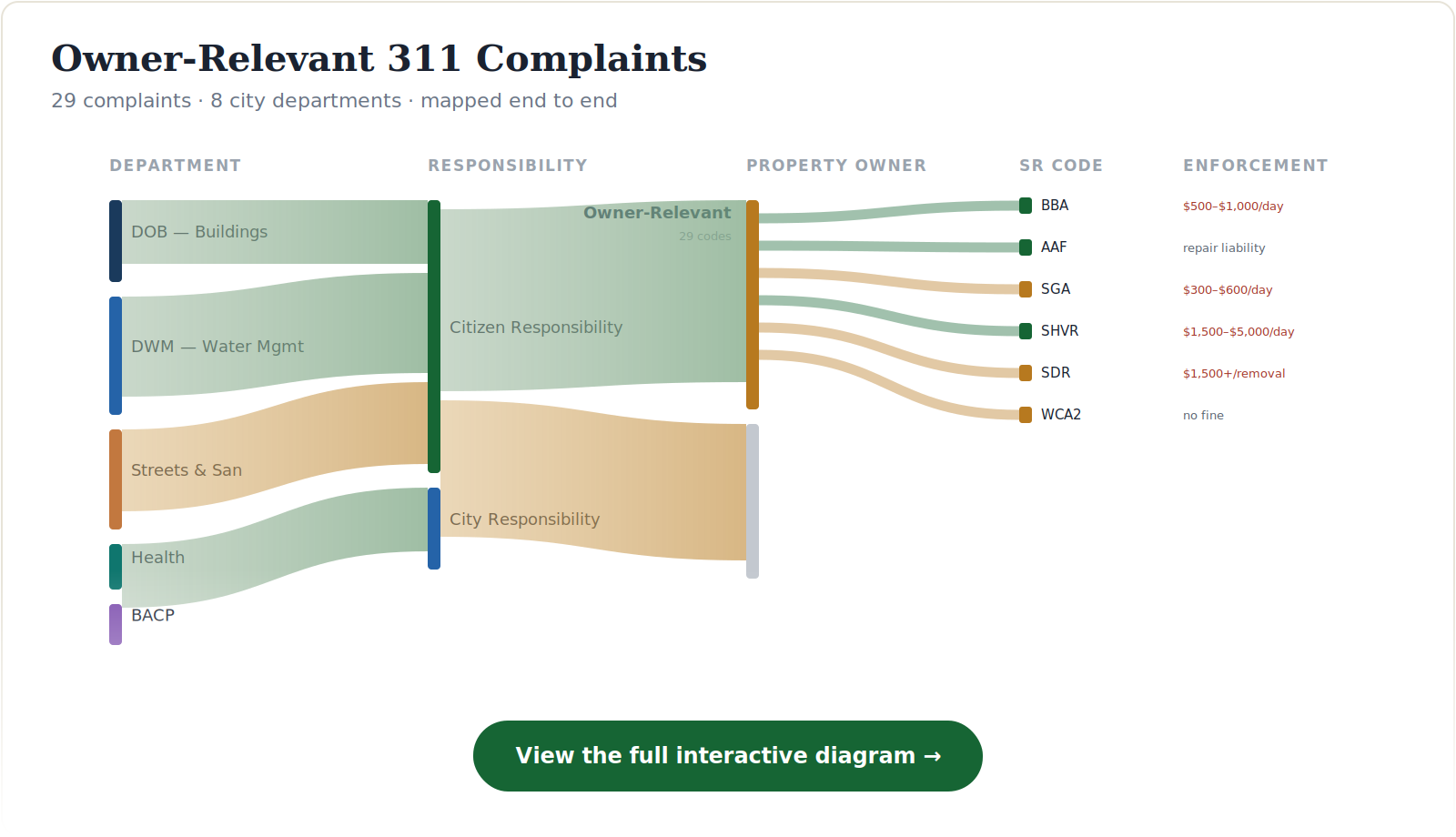
Owner-relevant 311 complaints — interactive diagram


Why the department matters more than the complaint

Three things decide how much any complaint should worry you, and all three flow from which department owns it.

The clock. Different departments have different steps and timelines to close a complaint. Buildings closes a plumbing violation after an inspection, a licensed repair, and a re-inspection (49 days). Water Management closes a basement-flooding complaint in 2.4 hours, because its cure is a technician confirming whose problem it is. Complaints are sometimes rerouted to different departments — if a loud or dirty construction site is reported as a building violation, it may be rerouted to Streets & Sanitation. And for Streets & San it particular, it could be months between a closed complaint and a fine is actually issued.

Who pays. Some complaints are the city's to fix and fund; most owner-relevant ones are enforced through fines, abatement, or liens. A few are ambiguous until resolution: a sewer cave-in is the city's if it's the main, yours if it's the lateral — and you won't know which until the inspector tells you (AAD/AAI, ~27 days, often because someone has to dig).

Whether the fine is real. The dollar figures below are statutory maximums from the Municipal Code of Chicago, not what you'll pay. The gap between the two is the whole game and it splits cleanly by department.

Buildings wants you to comply. Streets & San wants you to pay.

The Department of Buildings owns the violations everyone pictures — building, plumbing, no-permit, porch, vacant, no-heat/AC. The penalty under MCC 13-12-040 reads $500–$1,000 per day, per violation, which sounds ruinous. It isn't, in practice: the department is compliance-first, subordinates to your lender so you can finance repairs, and usually asks only a one-day minimum ($500 owner-occupied, $1,000 investment) to close. Attorney Zack Limbaugh makes this point across two Straight Up Chicago Investor episodes (ep 333 and 2026 follow-up): of every department, Buildings cares most about getting the building fixed, not collecting. The cost is time — the city has only "a few dozen" inspectors — and no-permit cases (BBD) are the cautionary tale: a 138-day median, the slowest quarter dragging past two years, because legalizing unpermitted work after the fact means open walls, new drawings, sometimes a zoning fight. (One trap: the city's violation website is a history of inspections, not current status — the same seven violations re-listed can look like eighty, and the city often never marks corrected ones closed. The document that matters is a signed permit or a final compliance order, which is why we track real status at the address level.)

Streets & Sanitation is the opposite. It owns the outdoor nuisances — rat baiting (the city's single highest-volume owner complaint at ~45,000 cases), weeds and vacant-lot cleanup (abatement-and-lien under MCC 7-28-120), sanitation, recycling, fly dumping — and Limbaugh describes it leaning hard into these as a revenue source. Three things to know: the lag is six-to-nine months from violation to notice; a single debris pile gets cited twice ("trash" and "materials and junk") to double the fine; and the city names anyone "remotely related" to a property then defaults the fines and consolidates liens across all your properties to collect.

The single most useful habit here: if someone fly-dumps on your property, report it to 311 and clean it up. That 311 record is what gets a later Streets & San citation dismissed, because it proves the debris wasn't yours. Almost nobody does this — and it's the clearest reason to monitor the 311 feed at all: the record you file today is the defense you need in six months.

(On snow — SWSNOREM — the ordinance threatens $50–$500/day, but the city essentially never tickets it: zero closed cases all year. Shovel for the slip-and-fall liability, not the fine.)

Water Management, and the lead-test black hole

Nine codes sit with Water Management, and most carry no fine — just repair liability if the problem's on your line. The exception worth flagging is the slowest high-volume complaint in the entire city: the water lead test kit (WCA2) takes a 137-day median to resolve, with the test-visit code (WCA3) at 98. That's not a glitch. Chicago's own water-quality director told the City Council there aren't enough lead-sampling bottles in the country to meet demand, and the program ran zero tests during a maintenance month, leaving residents waiting months or years. When the city says the queue is four months, the data agrees.

The newest trap: the Health Department

CDPH has started sending inspectors to active construction sites for environmental citations — missing dust permits, torn screening, mud tracked off-site. They're brutal: $3,000–$10,000, non-negotiable, and you can't cure them after the fact by pulling a permit. You can have every Buildings permit in order and still get hit, because the health permit is separate and nothing flags it. Confirm CDPH requirements before you break ground. If you make use of our alerts, you can be notified same day of a potential complaint before it gets rerouted to CDPH.

The rest

BACP owns short-term-rental complaints (SHVR, MCC 4-6-300) — $1,500–$5,000/day for unlicensed operation — plus renter/foreclosure matters. Animal Care owns dangerous-animal complaints (EAF, MCC 7-12-090): $300–$500/day plus impound. Fire owns commercial fire-safety (FAC, MCC 15-4): $500/day after a 15-day notice. CDOT owns the shared-cost sidewalk program — an assessment, not a fine.


The same word — "violation" — means comply-on-your-schedule from Buildings and pay-now-maybe-doubled from Streets & San. Knowing the owning department tells you the timeline, the cost, and whether you're even on the hook, before you spend a dollar. It's why we surface the department and code section on every complaint we track, and alert on the ones that matter the day they're filed: the owners the city moves on fastest are the ones who move first, and for the revenue-driven departments, the owner with the record already on file is the one who walks away clean.

Search your address to see every open complaint, violation, permit, and record on any Cook County building — free. More on why one building can hide dozens of PINs and addresses.
June 2026 Feature Update

Over the last few months, the City Logical team has been toiling away in our office above a noisy Milwaukee Ave to bring Property Sentinel users the latest and greatest features in the world of Chicago property data. Stay tuned this week for posts covering the following: (1) How to Monitor Your Property Portfolio for City Activity, (2) The 311 Complaints That All Property Owners Should Care About, and (3) The City's 311 Data Feed.

One Address, How many PINs?

Cook County established the Property Index Number (PIN) system, officially known as the Permanent Real Estate Index Number System, in 1946. The modern 14-digit PIN encodes specific geographic information down to the unit:

05-17-417-020-0000
Area-Sub area-Block-Parcel-Unit
New Trier-Section 17-Block 417-Parcel 020-Standard Parcel

The county's official explainer and local lawfirms do a good job explaining the basic PIN facts and relevance for property taxes. Chicago Cityscape, a singular inspiration for this site, does a fantastic job (for a price) at aggregating property details for specific PINs. Property Sentinel is the only place you can type in a Cook County address and get all 311 complaints, property records & characteristics, and public listing details at that entire building—no matter the PIN number, could be none, could be 90—for free.

What Goes Into a Property Page

The Cook County Assessor publishes a number of separate datasets that we ingest on an ongoing, rolling basis. Key among these are the parcel universe (3.7 millions rows covering every parcel in the county), parcel sale history, assessed values, and property characteristics per class. For Chicago addresses specifically, we also have short term rental activity, 311 complaints, violations, and permits. This is only a partial accounting of our data infrastructure—see our Data Sources page for a full list.

The result is a property page that knows a building's latest assessed value (usually two years ahead of the city's own website), an indication if it's over-assessed (tool build in process), a complete set of characteristics, and full picture of listings/complaints/violations/permits.

The PIN Problem

Most addresses map cleanly to one PIN; Kevin McAllister's house at 671 Lincoln Ave is on a single parcel in Winnetka. Chicago's layers of large, old, and renovated buildings complicate this.

Cook County assigns PINs at the parcel level, and parcels follow legal lot lines, not building footprints. A courtyard building constructed on three contiguous lots has three PINs. A mixed-use building with a residential tower and a separate retail parcel has two. A landmark building occupying half a city block may have eight. If the PINs could talk, they'd tell you they're related—sequential PIN numbers at the same block or parcel with the same property tax mailing entity tend to be related—but there's no published record saying "these six PINs are actually the same building."

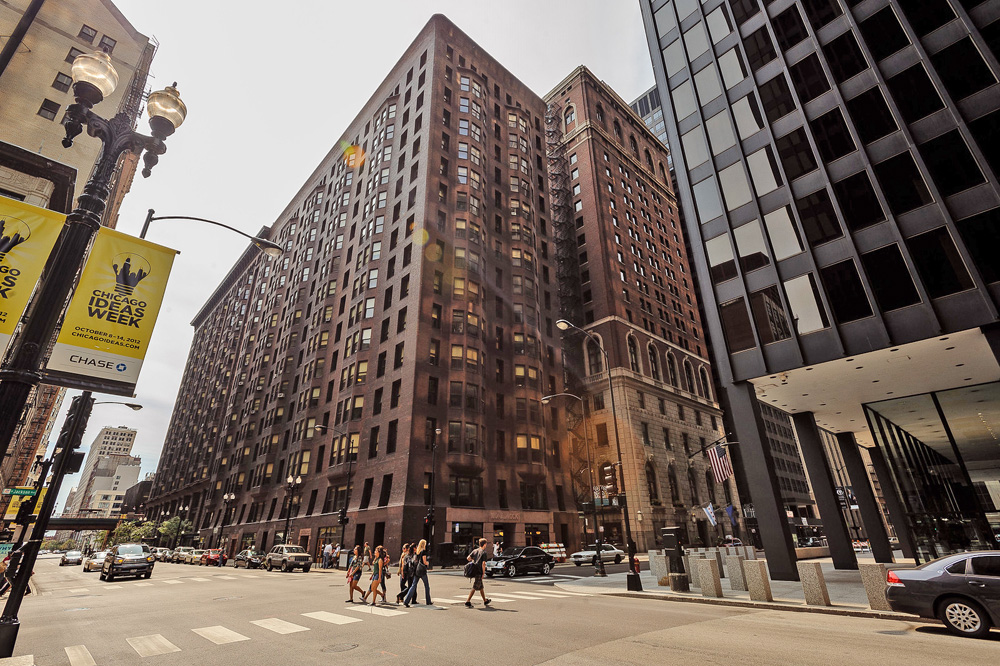
Take, for example, the historic Monadnock building. Designed by Burnham & Root back in 1891, 53 W Jackson Blvd. is still the tallest load-bearing brick building ever constructed.

The Monadnock Building, two halves built two years apart

Except that's half the story—the other half of the Monadnock was designed by Holabird & Roche and wasn't finished until 1893. That's a second parcel with a separate PIN. It also has 32 other addresses:

300-350 S DEARBORN ST CHICAGO IL 60604
325-325 S FEDERAL ST CHICAGO IL 60604
50-56 W VAN BUREN ST CHICAGO IL 60600
51 W JACKSON BLVD CHICAGO IL 60604

The former is crucial for getting the full picture on property characteristics and taxes; the latter is important for everything else. To my knowledge, Property Sentinel is the only site to do both.

Sibling Pin Matching

Our matching heuristic identifies "sibling" PINs using a few signals in combination: sequential PIN proximity within the same block, shared tax mailing name, consistent property class, and a fourth proprietary method. When a certain combination of the four align, we flag the parcels as siblings and merge their records under a unified building view. Records from all sibling addresses feed into a single timeline, assessed values are summed, and building characteristics are itemized and deduplicated.

Our matching works well for the straightforward cases—courtyard buildings on the North Side, large mixed-use buildings, etc—but it breaks down on edge cases. That's why, when you type in an address for a building with multiple PINs, you're given the opportunity to view the full building or just the solo address.

Hansen 7

Our jigsaw puzzle is still missing an important piece. The city of Chicago maintains a legacy address range database called Hansen 7 that maps every building to its full street address range. It's the reason we know the definitive addresses for the Monadnock and it's also the reason why the neighbor's complaints about the illegal short-term rental in your condo association are lost to the wind. Right now, the only way to query Hansen 7 is through a back door, looking up an address on the city's building records site. Our parent company, City Logical LLC, has filed a FOIA request for the Hansen 7 dataset—if and when that request is granted, it will be freely uploaded to our Github and will complement our sibling PIN heuristic here.

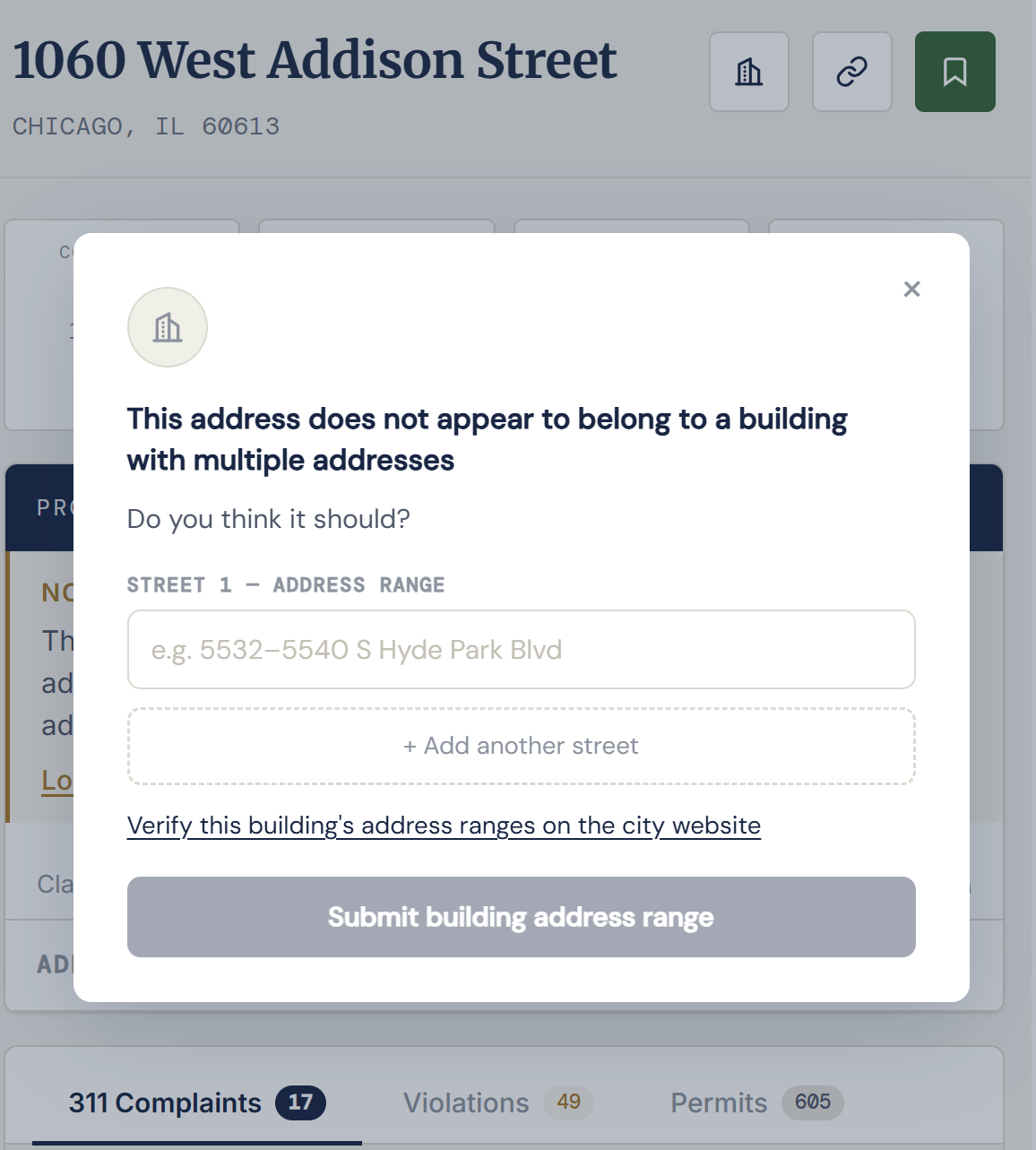
Until we receive the definitive address ranges from the city, we rely on an elegant fallback. If you know your building occupies multiple address ranges—a courtyard building, a large multi-family, a condo association with a parking garage on an adjacent parcel—you can submit those ranges directly from the property page. And if you don't know your building's address range, you can verify it on the city's website. We review every submission against the parcel records and, when confirmed, merge them into a unified building view.

Submitting a building's address ranges manually

6/15/26 Update

No FOIA, no problem. If the city can't provide the Hansen address ranges, we'll recreate them ourselves. As of this week, if you type in an address that belongs to a building with multiple addresses, we will automatically volunteer the Hansen address range. Combined with our four other address range and sibling PIN matching functions, this makes Property Sentinel the best solution for the tangled mess of Chicago addresses.

Search your address to get started.

Chicago 311 Complaints: What Building Owners Need to Know

The Second City logs an average of 1.5 million 311 complaints per year, more than one complaint for every two Chicagoans. Property Sentinel is the only place that tracks complaints by address and sends alerts for what's important. Though building complaints are our primary focus, we also track business and consumer complaints—restaurant inspections, wage violations, tobacco sales, and more. We'll cover those in a future post.

In January 1999, Chicago debuted a centralized 3-1-1 municipal service system to route non-emergency calls away from 9-1-1. Every year since, the city has recorded and responded to over a million complaints a year for everything from building violations to rodent baiting. In December 2018, the city fully modernized the 311 platform by releasing a web and mobile app alongside a free-to-access and comprehensive database. That database is the city's buried treasure—a geocoded catalogue of seven years and counting of citizen interactions with city services. City Logical was founded to make sense of that data; Property Sentinel concerns itself specifically with building-related complaints.

Complaint Types

Each complaint is tagged with a short code that denotes the approximate reason for the complaint: e.g. NAC for No Air Conditioning, CIAC for Coyote Interaction, HFF for Smokeless Tobacco at Sports. There are over 100 codes in total. Information Only Calls (50%) and Aircraft Noise (25%) are the most popular complaints by far and stand apart—no follow-up is required, no enforcement is expected, and no resolution is delivered. The real 311 complaints, about 400,000 per year, generate and demand an appropriate and prompt city response.

Top 10 Complaints from the Last 12 Months (LTM)

CodeTypeTotalOpenPer mo.
311IOC311 Info Only Call711,586059,299
AVNAircraft Noise379,643031,637
GRAFGraffiti Removal95,1184,7227,927
SKAAbandoned Vehicle53,1587,0834,430
PHFPothole in Street50,7267,7894,227
SIEGarbage Cart Maintenance50,5634,3794,214
SEFTree Trim (discontinued)45,40963,784
SGARodent Baiting/Rat44,4252,3183,702
SFDStreet Light Out35,6794,2212,973
SELTree Debris Clean-Up29,0861,6372,424

Building Complaints

Depending on how you slice it, there is a building complaint reported to Chicago 311 every four and a half minutes. Though some are more serious than others, all require a response from the relevant department: Department of Buildings (DoB) conducts a follow-up inspection for every no permit and plumbing complaint, Department of Water Management (DoWM) investigates basement flooding, and ward-level inspectors check out sanitation code violations. Depending on the circumstances, the inspection may result in a follow-up visit, which may itself require an additional inspection before the complaint is finally closed. As you might imagine, city inspectors are spread thin.

Serious Building Complaints and Response Times LTM

CodeTypeClosedMedianLower QuartileUpper Quartile
BBCPlumbing Violation6,91145.9 days16.8 days66.6 days
BBDNo Permit / Construction2,14535.8 days13.7 days72.8 days
BBABuilding Violation16,68016.7 days3.7 days50.1 days
SHVRShared Housing/STR4893.7 days1.5 days24.6 days
AAFWater in Basement19,2430.1 days0.0 days0.4 days

Water in basement resolves in 2.4 hours. That's not because the city fixes anything, it's because the DoWM dispatches someone to check the sewer, confirms whether it's a city-side or a building-side issue, and closes the ticket. The resolution is a triage, not a repair.

Plumbing violations take 46 days to resolve, nearly three times longer than general building violations, because they require an initial inspection, a licensed plumber to make repairs, and a reinspection to verify. The DoB is the bottleneck on both the initial and reinspection. The upper quartile of 67 days means one in four landlords has an open violation on their record for two months.

Shared housing/vacation rental complaints are handled by Business Affairs & Consumer Protection (BACP) and have a long tail: if you complain about the bachelor party happening at the AirBnB upstairs, the city either warns the host if they're in compliance or conducts an investigation of all the hosts' properties if they're not.

Building complaints are only one piece of the 311 picture. Chicago logged nearly 10,000 business-related complaints in the last 12 months—restaurant complaints, consumer fraud, wage theft, sidewalk café violations—each handled by a different department with its own enforcement timeline. We'll break those down in a separate post.

Staying Compliant

Each building complaint has its own nuances and learning curve. The city only has "a few dozen" building inspectors which means they are reactive by necessity, working through the queue of complaints as they come in, often prioritizing certain buildings and geographies over others. If you're a building owner, finding out about a complaint on the same day it's recorded allows for a quick call to your own plumber—possibly the difference between a quick inspection vs thousands of dollars in fines, or a clean bill of health vs an RLTO violation.

Property Sentinel alerts you to building & business complaints within a half hour of filing. It will also guide you through the complaint-to-resolution window, providing an estimate of inspector response times weighted on recent inspections, weather, time-of-year, and ward-level data. And if you need a recommended tradesman for the job, we're building a network for that too.

Search your address to get started.